
 +91-9811948545
 Get a Call Back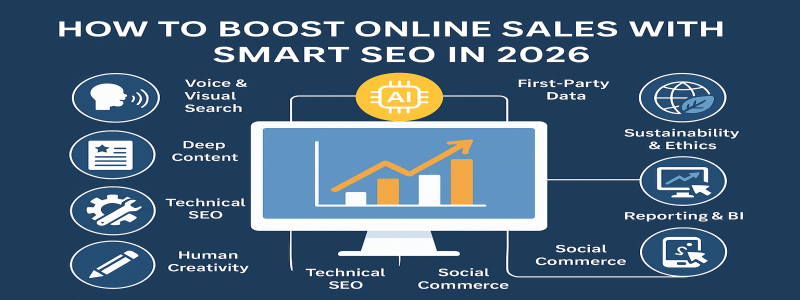
In 2026, online commerce is evolving rapidly, and so is the role of search engine optimisation (SEO). Gone are the days when keyword stuffing and generic backlink campaigns could guarantee growth. To boost online sales effectively, brands must adopt smart SEOa strategy focused on experience, trust, and intent, not just rankings. Drawing on cutting-edge trends, heres how you can position your e-commerce business to grow in 2026.
1. Shift from Rankings to Deep Experiences
- Increasing visibility is no longer just about appearing in search resultsits about how users engage with and convert from your site. Search engines now reward brands that prioritise discoverability, relevance, and customer satisfaction. TIS DigiTech+1 That means your SEO efforts should align with the entire buyer journeyhow prospects search, how they evaluate, and how they purchase.
- Focus on meaningful interactions: product feeds, reviews, visual and voice queries, structured data. Make every touchpoint count. Your website, product pages, and even your social presence must deliver value, clarity and speed.
2. Harness Voice and Visual Search
By 2026, voice and visual search are no longer fringetheyre mainstream. Consumers are using natural speech (Find sustainable packaging suppliers in Asia) or uploading images to discover products. TIS DigiTech
To capitalise:
- Optimize for conversational queries and long-tail phrases (how do I choose eco-friendly packaging).
- Ensure your product images, thumbnails and catalogues are properly tagged, described and accessible for visual search.
- Use schema markup for products and make sure your site structure is easily understood by AI assistants.
This extension of search means youll capture audiences before they even type a query.
3. Leverage AI-Driven Personalisation and Automation
AI is no longer optional. In fact, systems now analyse emerging keywords, user behaviour, and optimise meta data and internal links in real time. TIS DigiTech
For boosting online sales:
- Use machine-learning tools to identify high-intent keywords and trending topics relevant to your niche.
- Automate product titles, descriptions and meta tags to improve discoverability, but always maintain human brand voice.
- Personalise content based on first-party data (see next section) so users find what theyre looking for faster, increasing conversion rates.
4. Build on First-Party Data to Fuel SEO
With third-party cookies phasing out, first-party data is now a competitive edge. TIS DigiTech
Strategies include:
- Integrate your CRM/analytics with your SEO reporting to understand the user journey from discovery to purchase.
- Use behavioural insights (previous purchases, browsing history) to tailor content and product recommendations.
- Focus on quality over quantityi.e., keywords that your best customers actually convert onnot just high-volume searches.
By doing this, SEO becomes not just traffic-driven but sales-driven.
5. Deep-Content, Authority & Trust
In 2026, content depth beats content volume. Search engines are rewarding detailed guides, comparison pages, long-form storytelling, user reviews, video demos. TIS DigiTech
For your e-commerce site:
- Publish product manuals, how to choose, comparison guides, and user-generated content like reviews or case studies.
- Use interactive formats: 360-degree views, tutorials, calculators. These engage users, increase time on page, and send positive signals to search engines.
- Especially for B2B e-commerce, demonstrate expertise with whitepapers and case studies (which also build credibility). TIS DigiTech
When users trust you, they buy from youand thats the goal of smart SEO.
6. Master Technical SEO: Core Web Vitals 3.0
User experience sits at the foundation of converting visits into sales. Technical SEO is non-negotiable. In 2026, the focus is on interactivity, responsiveness and mobile adaptability. TIS DigiTech
Ensure:
- Page load time is under around 2 seconds.
- Your site is mobile-first (since more users will shop on mobile).
- Pages use HTTPS, provide privacy notices, and have clean structured data / schema markup.
- Internal linking is logical and supports smooth navigation from discovery purchase.
These elements not only help rankings but significantly impact user drop-off and conversion.
7. Integrate Social Commerce + SEO for Unified Discoverability
Search and social are converging. Platforms like Instagram, TikTok and YouTube are now discovery engines as much as Google. TIS DigiTech
Actionable steps:
- Treat social posts like search assets: captions, descriptions and hashtags become metadata.
- Ensure that your social content reinforces your brands discoverability and links back to key product pages.
- Create unified content across web, mobile, and social so that your brand is consistently visible. When a user sees you on social and then finds you via search, the familiarity can boost trust and conversion.
8. Emphasise Sustainability & Ethical SEO
Consumers and search engines alike are paying attention to transparency, ethics and sustainability. TIS DigiTech
For e-commerce sites:
- Highlight eco-friendly materials, ethical sourcing and inclusive supply chains in your product pages.
- Use structured data to tag sustainability credentials.
- Tell stories of your commitments (carbon footprint reduction, fair-trade).
- This builds trust and aligns your SEO with values that resonateand help boost conversions.
9. Use Reporting as Business Intelligence
Smart SEO isnt just about clicksits about revenue, retention and lifetime value. TIS DigiTech
- Deploy dashboards that tie organic traffic to sales, not just rankings.
- Use predictive modelling: If we improve page load time by 0.5s, how much will our conversion rate increase?
- Regularly review which keywords are driving buyers, not just visitors, and adjust strategy accordingly.
This turns SEO into a strategic growth lever, not just a marketing silo.
10. Balance Automation with Human Creativity
Finally, even in an AI-driven world, humans matter. Creativity, storytelling and brand voice differentiate you in the market. TIS DigiTech
Ensure that:
- Your brand narrative is clear, emotionally engaging and consistent across touchpoints.
- You leverage AI for scale, but humans for tone, context and value.
- You craft experiences, not just optimized pages. If users feel something, theyre more likely to buy.
Conclusion
To boost online sales in 2026, smart SEO is about much more than keywords and backlinks. Its about delivering a seamless, relevant and trusted experience. From voice/visual search to AI-personalisation, from ethical transparency to technical excellenceyour SEO must evolve. By combining data, automation and human insight, your brand can not only attract visitors, but convert them into loyal customers.
When you implement these strategies, your e-commerce business will be ready for the futureboosting sales, building authority and standing out in a crowded online marketplace.