
 +91-9811948545
 Get a Call Back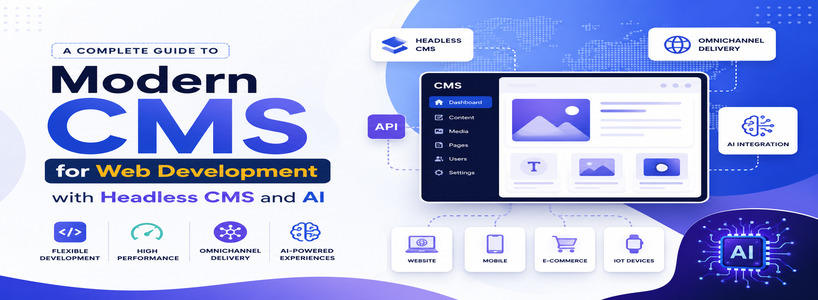
Putting up pages is no longer the only way of managing a website. Companies now have to create content in a hurry, provide a similar experience on their various platforms and get their websites prepared in anticipation of expansion in the future. That is why the selection of the CMS for web development has become a major choice. Contemporary content management platforms are more flexible than traditional ones, enabling businesses to manage websites in a more effective way, as well as keeping up with evolving customer demands. Lets discuss more.
What Is Changing in Content Management?
Conventional CMS systems are a combination of content management and a web presentation system. Although this generally works well on many websites, businesses with expanding digital needs may frequently need more flexibility.
In modern days, there is a shift of numerous organizations toward Headless CMS. Under this strategy, the content is controlled by individuals other than the web designer. It enables developers to show the same content across websites, mobile applications, customer portals, and other digital platforms without having to create it on different occasions.
This model provides more control and less content management to those businesses planning long-term digital growth.
Why Headless CMS Is Becoming Popular
A Headless CMS allows organizations to be more liberated in the creation of modern websites. Developers no longer have to be stuck with a specific front-end design: they can build various user experiences, and all content is stored and managed in one location.
Some key advantages include:
- Faster content updates
- Better flexibility for developers
- Easy integration with websites and mobile applications
- Improved scalability for growing businesses
- Uniform content on various platforms.
The appropriate CMS used in the creation of a website can help simplify the process of managing the website and allow expansion in the future.
How AI Is Improving Content Management
Artificial Intelligence is transforming the way businesses handle digital content. Rather than displacing content creators, AI can enable teams to produce at a higher capacity by assisting with routine activities.
AI-powered CMS platforms can help with:
- Content organization
- Search improvement
- Content recommendations
- Workflow management
- Content tagging and categorization
These enable the business to handle a huge amount of content and cut down on manual labor. Planning and human review are still vital requirements, yet AI will speed up and arrange daily content management.
Headless CMS vs Traditional CMS
| Feature | Traditional CMS | Headless CMS |
| Content & Design | Connected | Separate |
| Multi-platform Publishing | Limited | Easy |
| Development Flexibility | Moderate | High |
| Content Reuse | Limited | Better |
| Future Scalability | Moderate | High |
How Businesses Can Prepare
Not all businesses will have to convert to a Headless CMS right away. The correct decision will be based on business objectives, site complexity and future online strategies.
Businesses must take into account:
- Current website requirements
- Future expansion plans
- Integration with other business systems
- Ease of content management
- Long-term maintenance and support
Working with an experienced development team helps businesses choose a solution that matches both current and future requirements.
Building Websites for the Future
The content management is still developing as businesses will demand more flexibility, quicker updates and improved online experiences. Headless CMS and AI-powered content management are assisting companies to be ready to these varied requirements yet maintain site administration easy and efficient. Whether you are establishing a new site on the web or updating an old version, selecting the correct CMS for web development is a step towards long-term prosperity.
Contact WeblinkIndia.Net to investigate the possibilities of developing modern web solutions to support the creation of future-proof websites, which are scalable.